RISE.
An AI-powered platform that turns sustainability challenges into funded, impactful projects — connecting innovators, solution providers and financiers across a single six-stage pipeline.
- Role
- UI/UX Designer
- Type
- Web · Admin Dashboard
- Year
- 2025
- Tools
- Figma · Lovable · ChatGPT
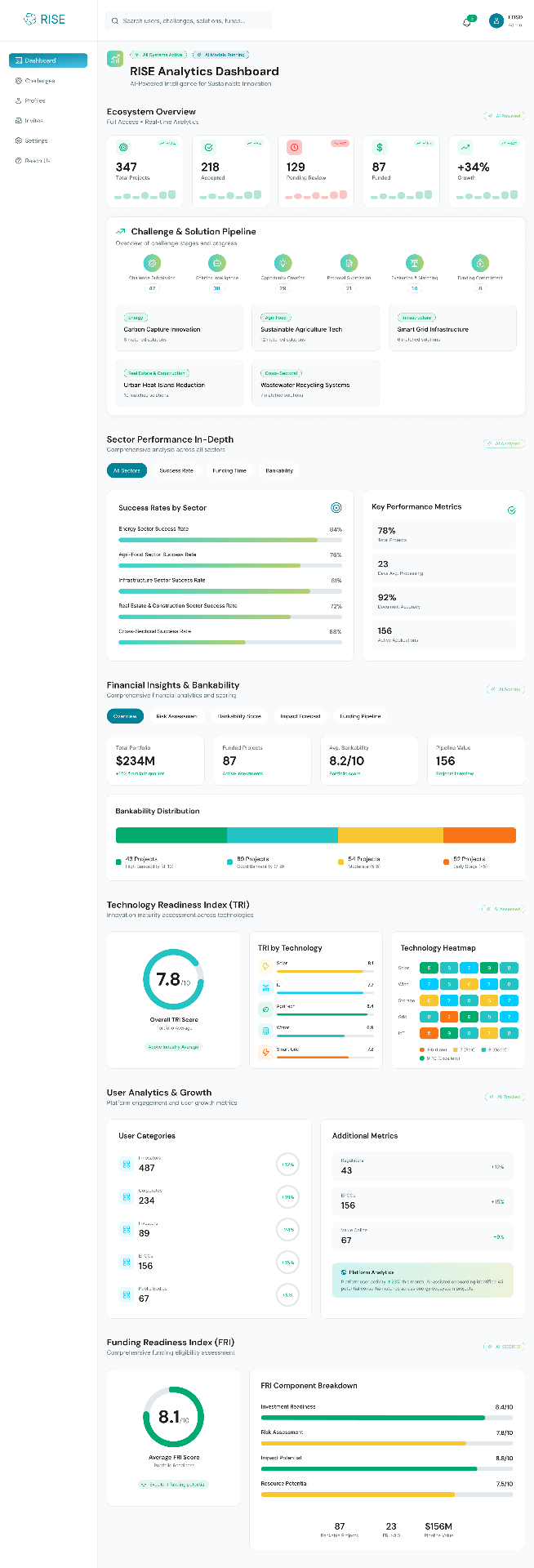
A pipeline, a co-pilot, and a ledger.
RISE is built around one idea: a sustainability challenge should travel a single, visible pipeline from the moment it is posted to the moment it is funded. Sera, the embedded AI, scores impact and viability at every step, and a financier's portfolio view sits at the end of the same rail — no hand-offs, no exports, no rebuilt context.
Sustainable capital is slow because context keeps resetting.
Four roles, one shared timeline.
Governments, NGOs and corporates who post the problems that need solving.
Startups, SMEs and large enterprises that propose technologies and services.
Banks, funds and DFIs that commit capital, with risk and bankability surfaced inline.
EOSD operators who manage users, AI prompts, invites and support.
One sidebar, six destinations.
The Challenges destination unfolds into the six-stage funding pipeline: Challenge Submission → Solution Intelligence → Opportunity Creation → Proposal Submission → Evaluation & Matching → Funding Commitment.
Ten screens, one funding ecosystem.
Each screen below earns its place in the pipeline. Captions explain the decision, not the obvious.
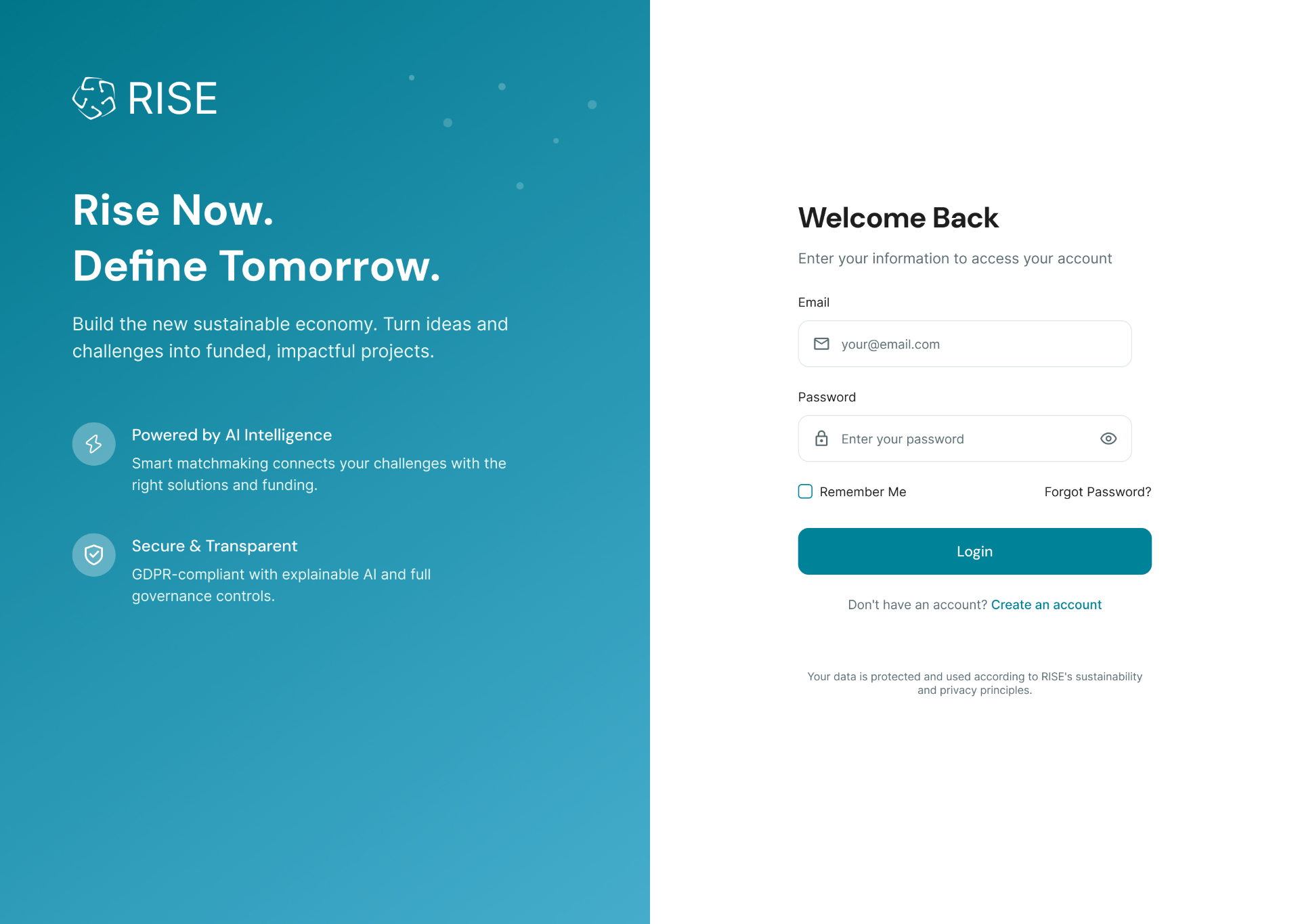
Split-screen brand promise — 'Rise Now. Define Tomorrow.' — with the value props (AI matchmaking, GDPR governance) carried by the gradient panel so the form stays a single calm column.
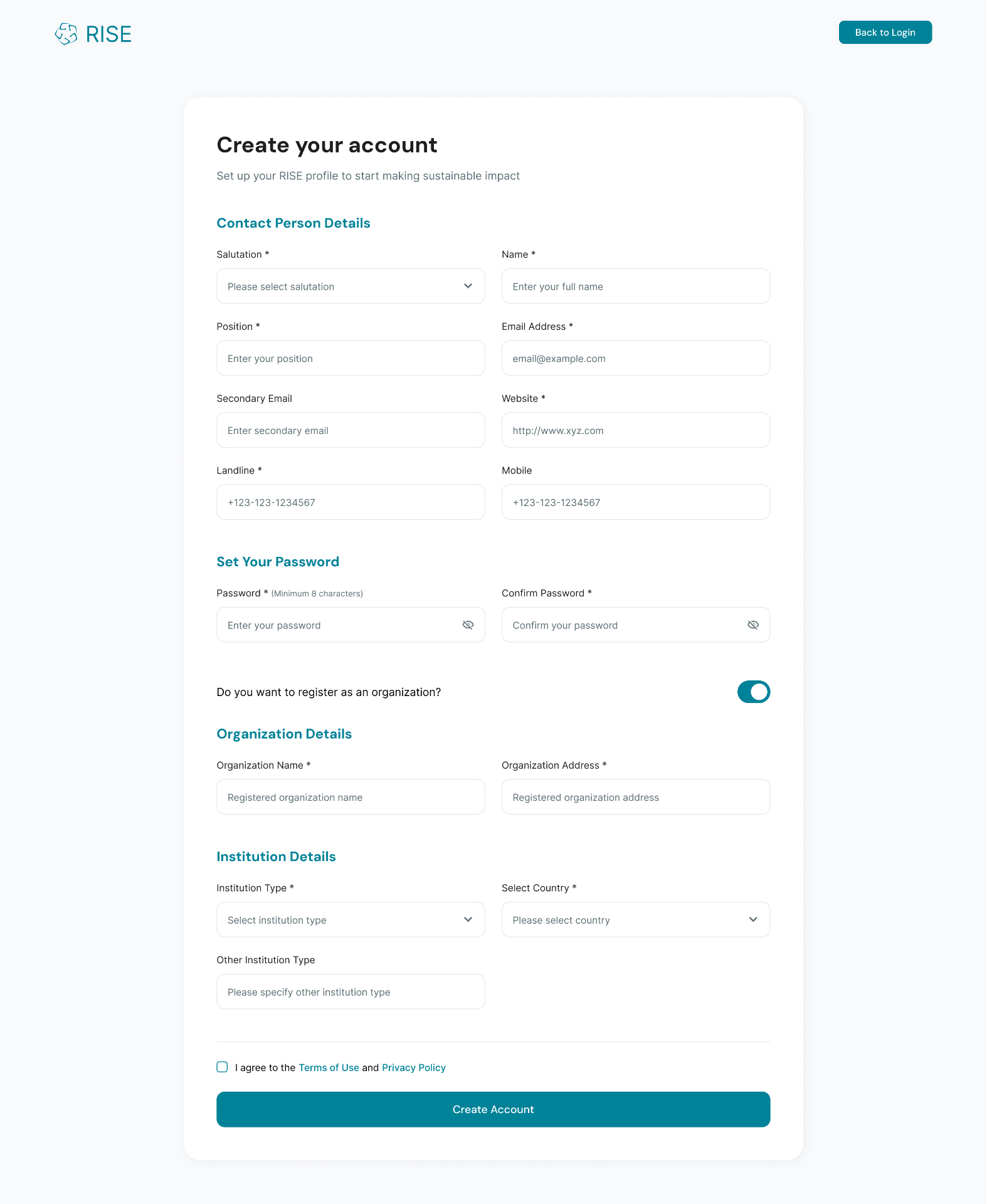
One scrollable form grouped by intent — Contact, Password, Organization, Institution — with a toggle that reveals organization fields only when needed, so individual users never see noise.
Ecosystem KPIs, a six-stage challenge pipeline, sector performance, financial insights, TRI, FRI, and user growth — one scroll that answers 'how is the platform doing?' for every stakeholder.
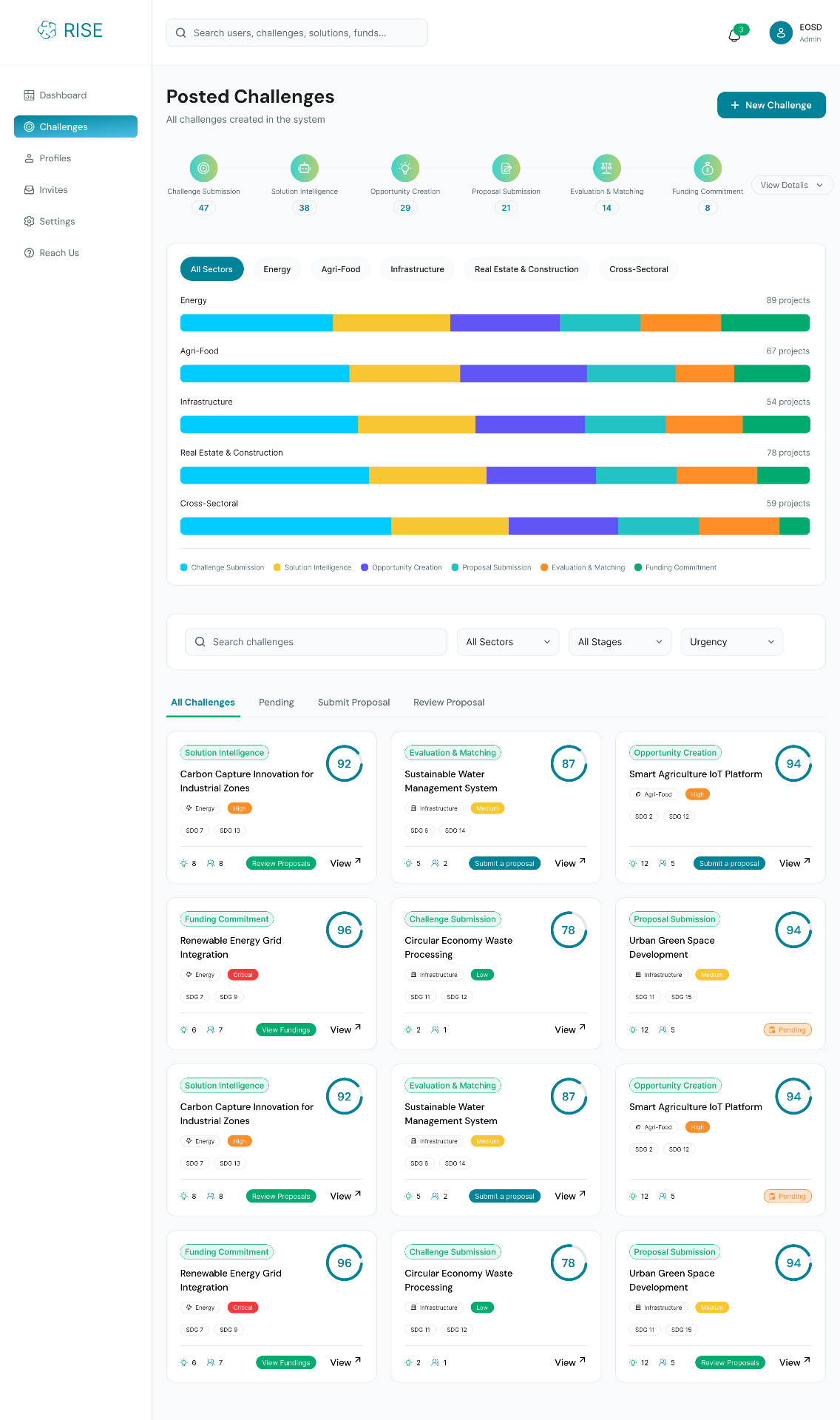
Pipeline header + sector-stacked bar charts above filterable challenge cards. Stage, urgency, SDGs, and the contextual primary action (Review Proposals · Submit · View Fundings) live on each card.
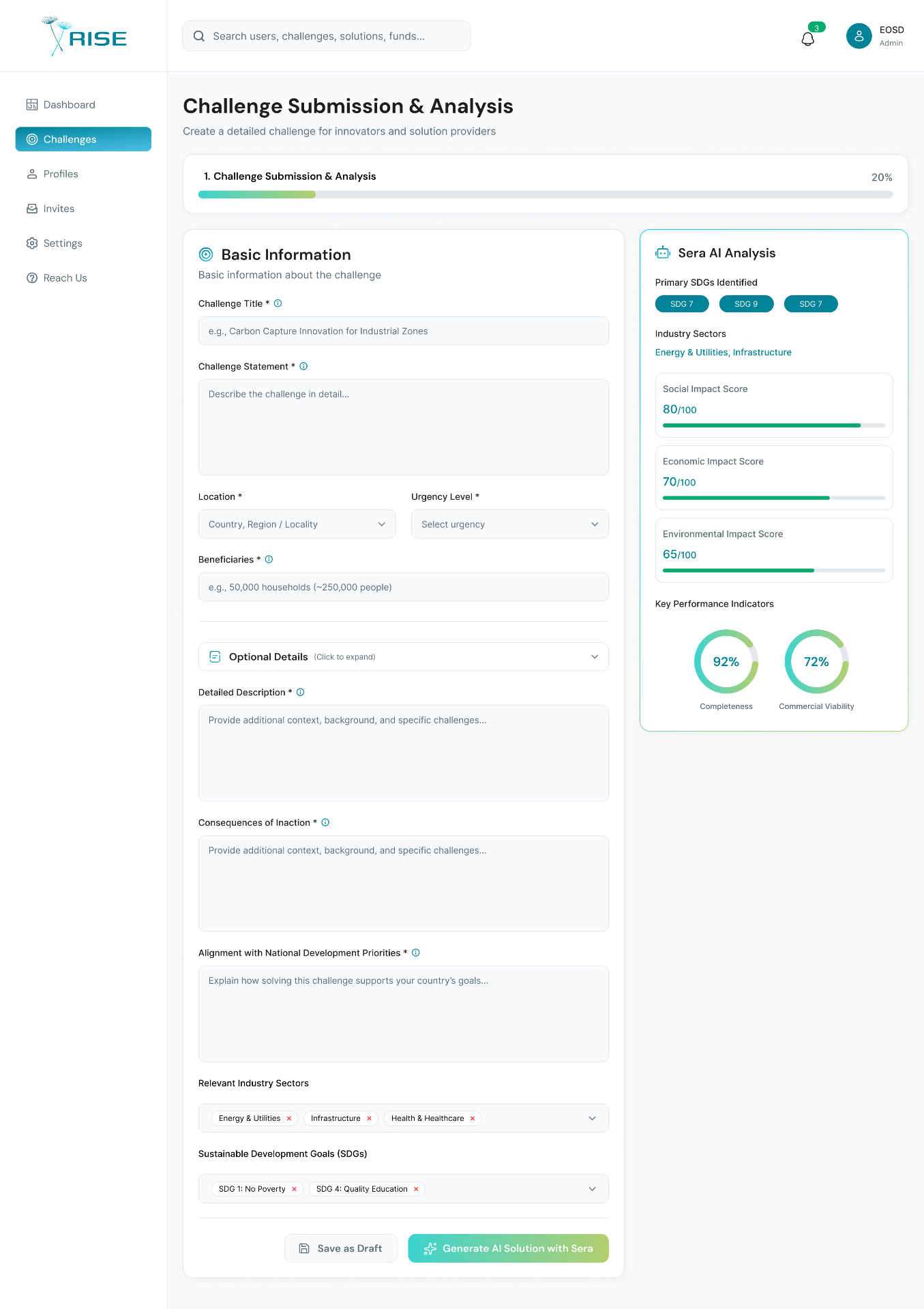
Long structured form on the left, Sera AI co-pilot on the right — primary SDGs, impact scores, completeness and commercial viability update live as the user types, so AI is a side panel, not a modal.
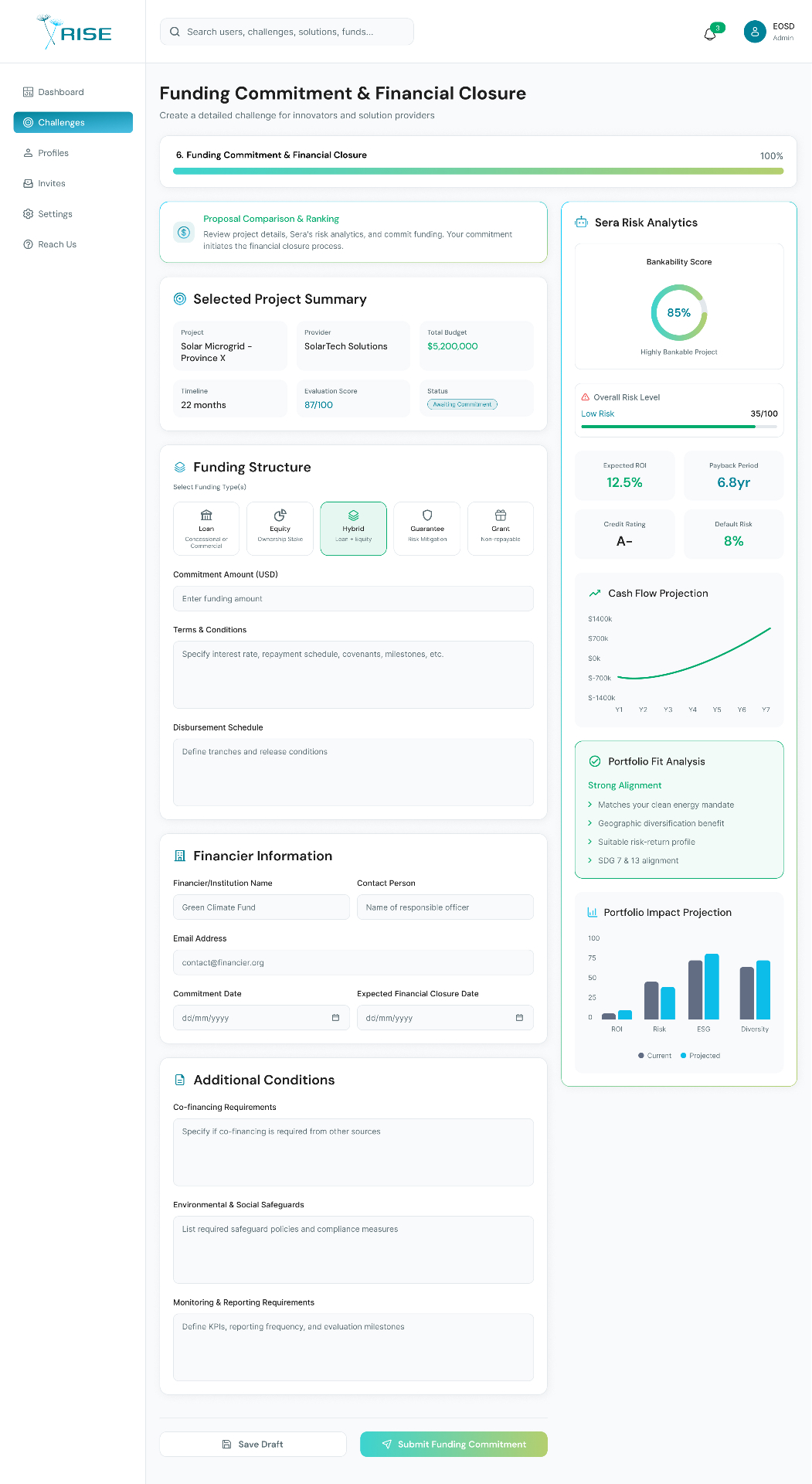
Funding type picker, terms, disbursement schedule and financier info on the left; Sera's risk analytics, cash-flow projection, portfolio fit, and impact projection on the right — the entire commitment decision on one page.
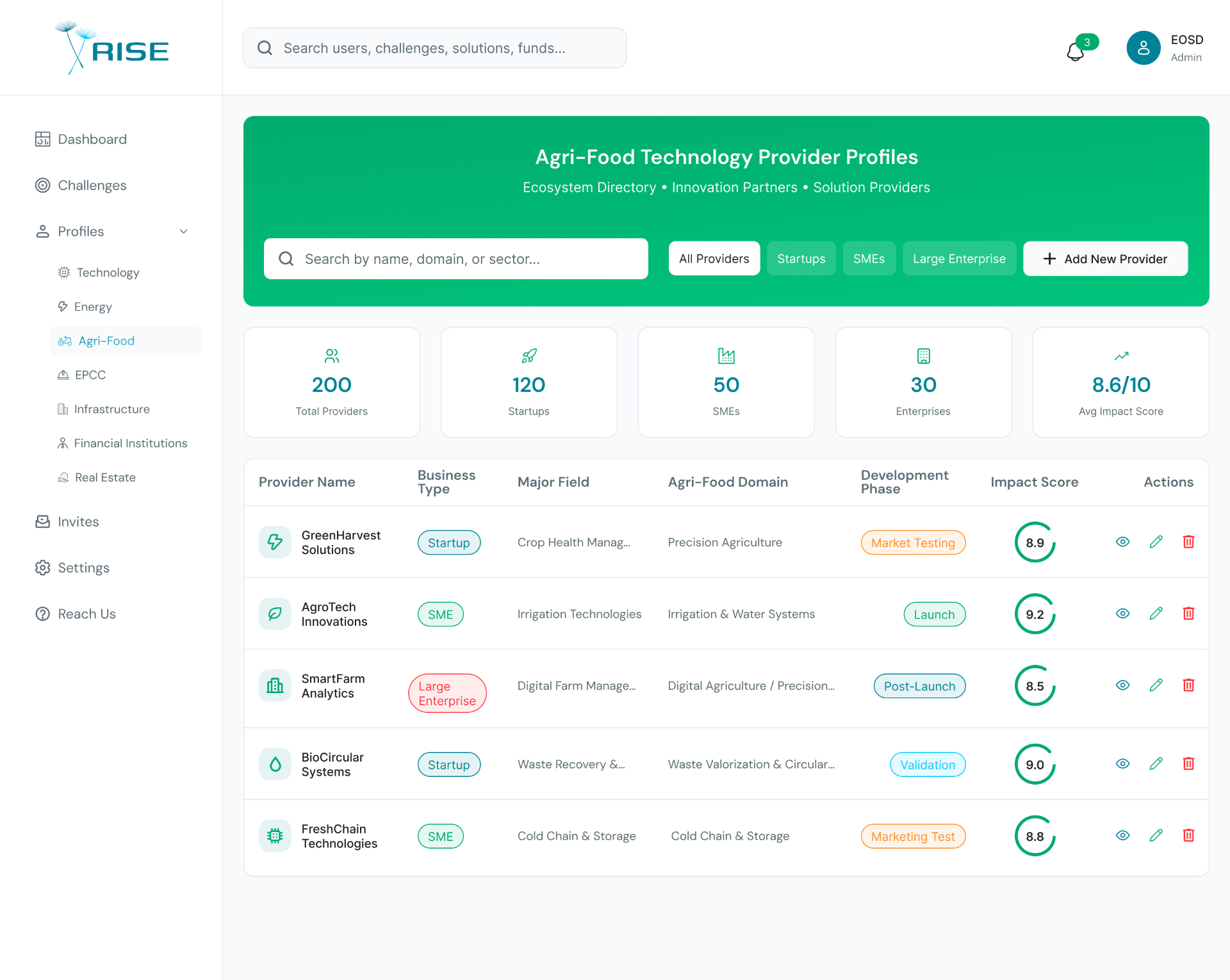
Sector-scoped directory (Agri-Food shown) with five KPI tiles, segmented filters (All · Startups · SMEs · Large Enterprise) and a domain-level table with development phase and impact score per provider.
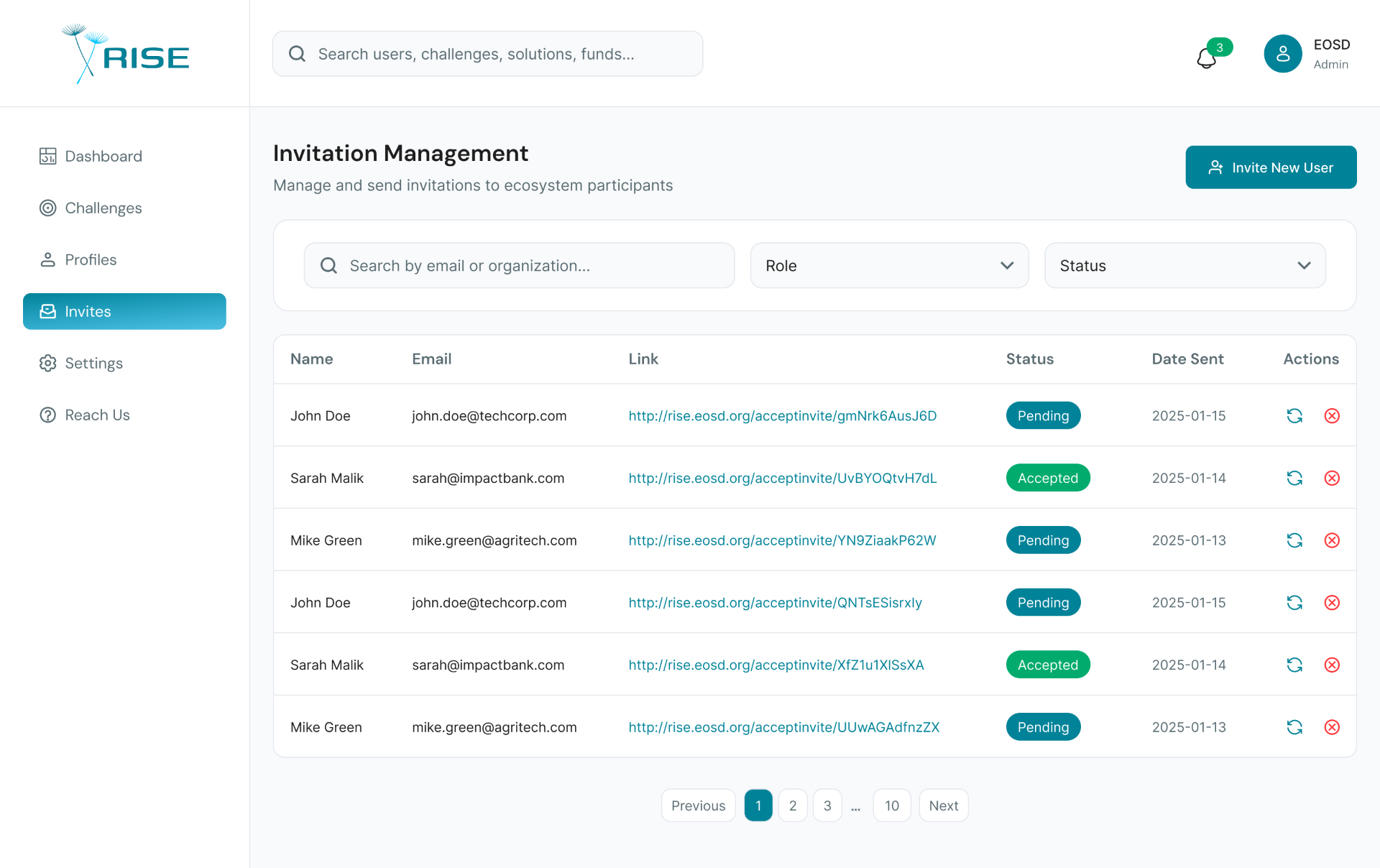
Email-driven role invites with copyable accept links, status badges (Pending · Accepted), resend and revoke actions — admins onboard ecosystem participants without leaving the table.
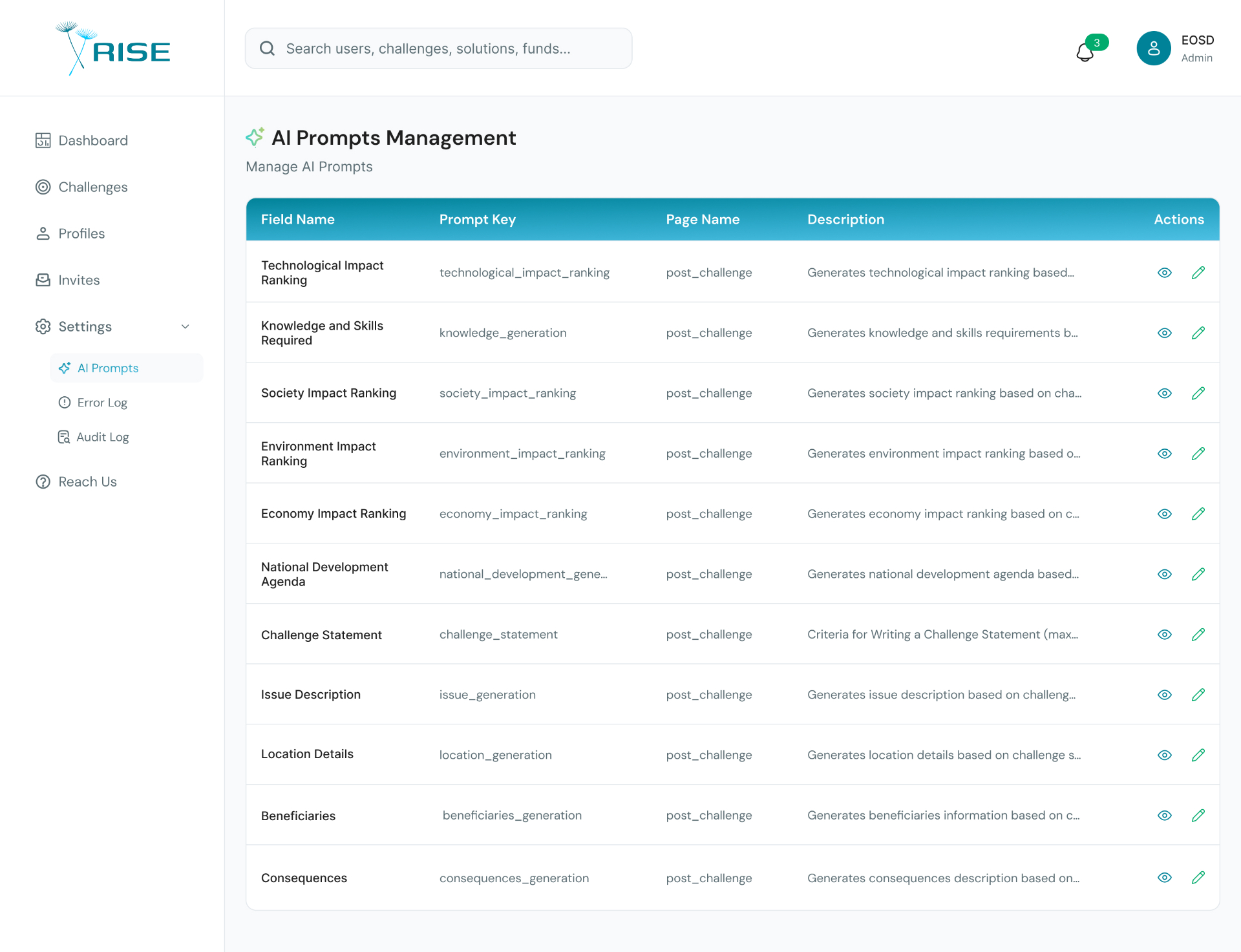
Every Sera AI field is a row: field name, prompt key, page, description, and inline view/edit — so admins tune the AI without touching code or shipping a release.
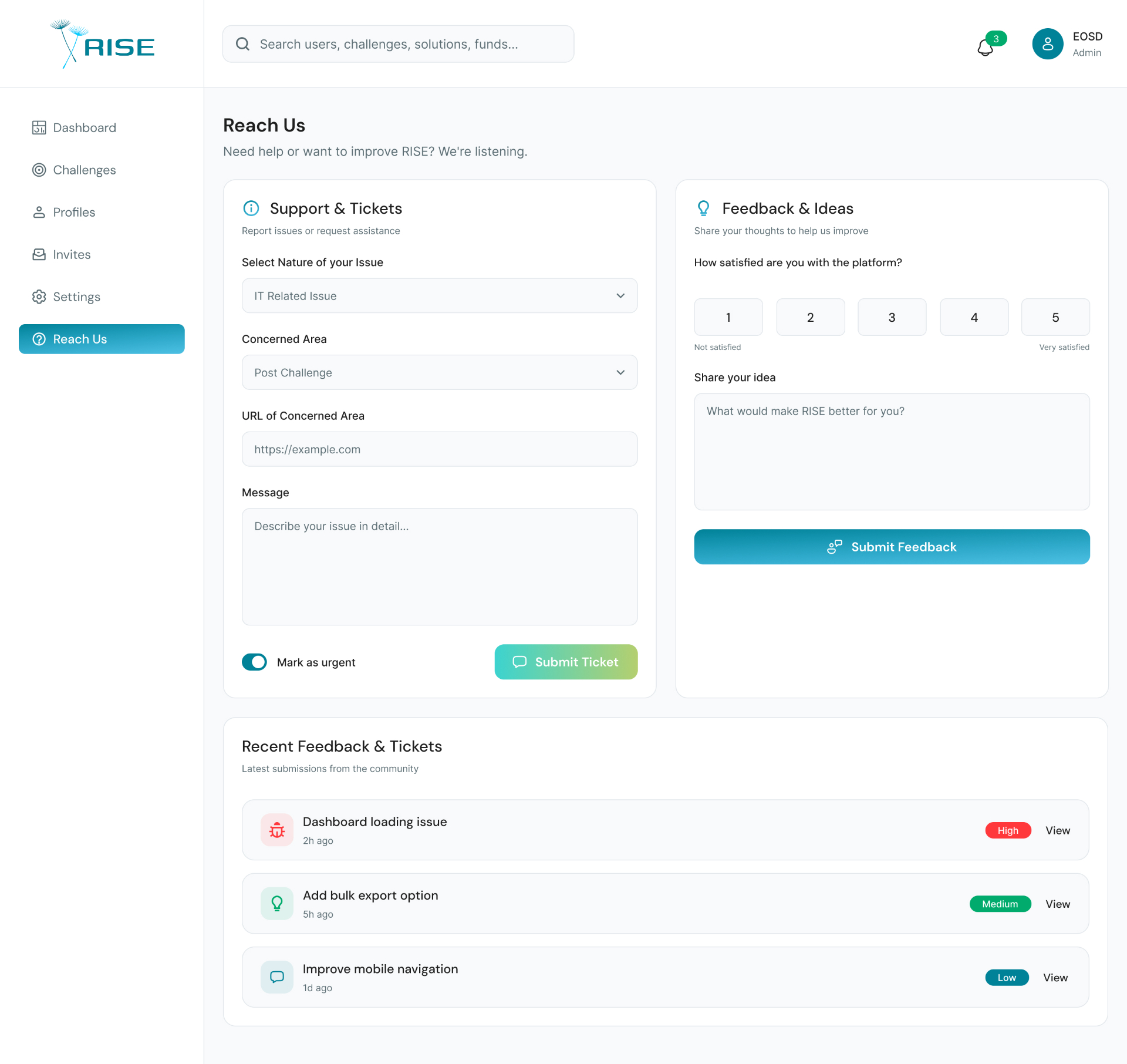
Support tickets and product feedback split into two equally-weighted cards, with a 1–5 satisfaction strip and a recent submissions feed below — one page for both 'something is broken' and 'something could be better'.
Six choices that shaped RISE.
Sera's analysis lives next to every form so scores, SDGs and risk update as the user types — never an interruption, never a separate trip.
Submission → Solution → Opportunity → Proposal → Evaluation → Funding is the spine of the product; the same chip strip appears on the dashboard, challenge list, and every detail page.
Social, economic, environmental, bankability, TRI, FRI — each score reads as a tinted progress bar or ring first, number second, so non-analysts can scan a portfolio.
Admins issue scoped invite links; the registration form adapts to whether the invitee is an individual or an organization, so RBAC is set up before the first login.
AI Prompts Management surfaces every Sera prompt as an editable record with a key, page, and description — product owners iterate prompts without a deploy.
Tickets and ideas live side by side with an urgency toggle and a community feed underneath — the loop from issue to fix to changelog is one URL.